Concealed scars
Hidden access points may reduce visible scarring.
Endoscopic osteoma removal uses concealed incision placement and advanced surgical access to remove selected benign bony growths while minimising visible scarring.
This approach may be particularly suitable for carefully selected patients prioritising aesthetic scar concealment.
Endoscopic osteoma removal uses strategically hidden access points, often within the hairline, to minimise visible scars while addressing selected osteomas.
This technique may be suitable where osteoma location, size and anatomy allow minimally invasive access.
Where anatomy is less suitable, direct osteoma removal may remain the safer or more predictable option.
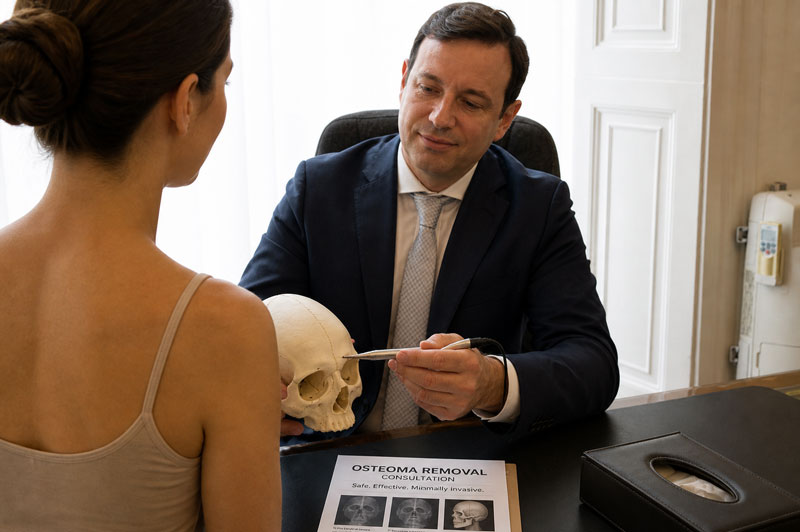
Endoscopic removal may be considered where lesion anatomy is suitable and scar concealment is a major treatment goal.
Hidden access points may reduce visible scarring.
Particularly relevant for selected forehead contour concerns.
Supporting smoother bony contour restoration.
Reducing visible incision exposure where suitable.
Surgical planning focuses on osteoma suitability, hidden access and safe structural refinement.
Osteoma anatomy and suitability for endoscopic treatment are reviewed.
Access is often designed to minimise visible scarring.
Advanced visualisation supports osteoma excision.
Smooth structural contour is restored where appropriate.
Larger or more complex osteomas may still require direct surgical removal.
Healing focuses on tissue recovery, hidden incision healing and progressive contour improvement.
Suitability for endoscopic treatment is carefully assessed.
Endoscopic access is used to remove the osteoma where appropriate.
Recovery supports scar concealment and contour restoration.
Structural refinement continues to settle over time.
These answers provide general guidance. Suitability depends on lesion anatomy, size and treatment goals.
If you are considering plastic surgery, a private & professional consultation provides the opportunity to explore suitable treatment options, ask questions and receive clear, tailored advice based on your goals.
Complete the form to arrange a consultation at Harley Street in London. We will reply to you very quickly to arrange.