Raised moles
Removing selected raised moles that are prominent or catch easily.
Mole removal is performed to remove selected benign moles with attention to diagnosis, safety and cosmetic outcome.
Treatment planning considers the mole’s appearance, location, size and whether histology is appropriate following removal.
Moles may be removed for practical, cosmetic or diagnostic reasons depending on their appearance, behaviour and location.
The technique is selected according to the mole type and surrounding skin, with careful planning to minimise visible scarring where possible.
Other benign lesions may require different approaches, including cyst removal, lipoma removal or osteoma removal.
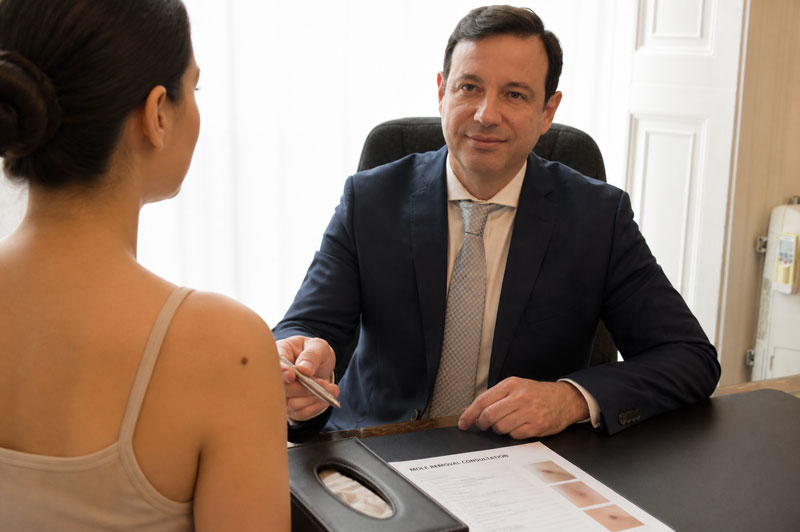
Mole removal may be considered where a mole causes irritation, catches on clothing or is cosmetically noticeable.
Removing selected raised moles that are prominent or catch easily.
Addressing visible moles where appearance is a concern.
Treating moles that become irritated by clothing, shaving or friction.
Where appropriate, removed tissue may be sent for analysis.
Mole removal is planned carefully according to size, depth, position and whether tissue analysis is required.
The mole is assessed for appearance, location and suitability for removal.
The removal method is chosen according to mole type and skin characteristics.
Where excision is needed, closure is planned to support discreet healing.
Tissue may be sent for laboratory analysis where clinically appropriate.
If a lump lies deeper beneath the skin, a different approach such as lipoma removal or cyst removal may be more appropriate.
Mole removal is usually a focused procedure, with aftercare centred on wound healing and scar optimisation.
The mole is assessed and the most suitable removal option is discussed.
The mole is removed using a technique matched to its type and position.
Wound care and scar advice are provided to support healing.
Histology or review may be arranged where appropriate.
These answers provide general guidance. Suitability depends on mole type, location and clinical assessment.
If you are considering plastic surgery, a private & professional consultation provides the opportunity to explore suitable treatment options, ask questions and receive clear, tailored advice based on your goals.
Complete the form to arrange a consultation at Harley Street in London. We will reply to you very quickly to arrange.